From the CPO's Desk
Tradition, Technology and Transformation:
Tribal Practices in Central India

Author
Shri. Swapnil Girade
Chief Program Officer & Head, STRC
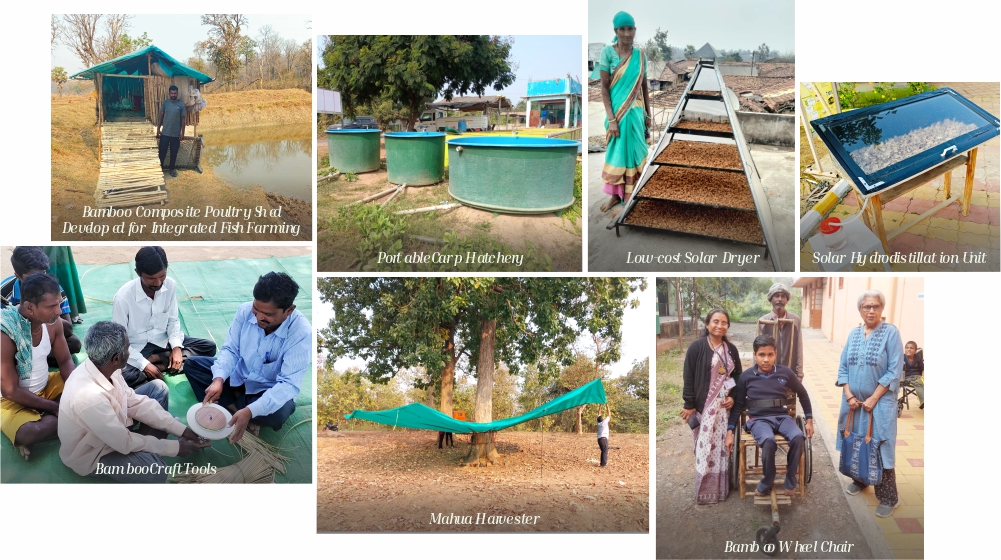
Grassroot Technologies, Developed by STRC and Technology Transfer through Collaborated Institutes ⤴︎
Tribal communities in Central India, particularly in Gadchiroli, Chandrapur, and adjoining regions, have nurtured a living repository of indigenous technologies and cultural practices. These practices—intertwined with agriculture, forest resource management, housing, lifestyle, and craft traditions—reflect centuries of adaptation, experimentation, and wisdom. While many such practices are inherently sustainable, resource-efficient, and climate-resilient, some have become ecologically unsustainable in today’s socio-economic context. To move forward, there is a need to preserve the best practices while introducing improved, eco-friendly alternatives that secure both livelihoods and ecosystems.
~ Non-Timber Forest Produce and Honey Harvesting
Non-Timber Forest Produce (NTFP) forms the backbone of livelihoods for tribal households. Yet, methods such as burning forest floors for mahua collection or destructive honey harvesting threaten biodiversity and long-term sustainability. Interventions like non-destructive honey collection, sustainable NTFP harvesting (eg. Mahua Harvester, Honey Harvesting Kit, High Capacity Air Blowers, etc.) and improved primary processing at source can protect ecosystems while securing steady incomes for communities.
~ Housing and Lifestyle Practices
Traditional tribal housing offers lessons in climate-responsive, resource-efficient architecture. Bamboo-reinforced soil walls, thatch or tile roofing, and cow dung flooring showcase ecological living at its best—combining insulation, hygiene, and natural pest control. The semi-rural evolution of tribal housing still retains these core strengths, offering low-cost, eco-friendly models that can inspire climate-adaptive rural housing at scale.
~ Bamboo in Everyday Life
Bamboo plays a central role in tribal livelihoods, from household utility items to agricultural implements and craft traditions. With scientific interventions such as treatment for durability, modern designs, and artisan training, bamboo practices can evolve into enterprises that drive local economies and link artisans to sustainable national and global value chains.
~ Fishing Tools and Technologies
Fishing practices illustrate the ingenuity of tribal knowledge. Bamboo traps designed for species-specific catches and seasonal fishing cycles embody ecological balance. Collective fishing strategies reinforces cultural ties and knowledge transfer. With minor scientific upgrades—durable materials, hygienic handling, and safety improvements—these practices can transition into small-scale enterprises while retaining sustainability.
~ Indigenous Agricultural Practices
Traditional cropping decisions reflect accumulated wisdom and resilience that can be enhanced through soil moisture conservation, community-based water management, and organic pest control. Such practices can strengthen food security while preparing communities to adapt to shifting climatic conditions.
A Step Towards Technology Integration and Transformation
Science and Technology Resource Centre (STRC), Gondwana University, Gadchiroli, in collaboration with the National Innovation Foundation (NIF), has initiated a focused program to identify, validate, and pilot tribal technologies in agriculture, NTFP, bamboo, housing, and lifestyle practices. This initiative is not only preserving indigenous knowledge, but also translating it into scalable, modern solutions that align with circular economy principles.
The journey ahead is not about replacing tribal knowledge but amplifying its relevance with scientific rigor. STRC envisions Gadchiroli and Chandrapur as hubs where indigenous knowledge and modern science converge to co-create ecologically sound, economically viable, and culturally rooted solutions. Through sustained collaborations with national institutions, grassroot innovations can be transformed into mainstream technologies—contributing to sustainable livelihoods, resilient communities, and a greener future for India.