From the CPO's Desk
Medicinal Plant Conservation as a Pathway to Ecological Sustainability and Community Livelihoods in Gadchiroli

Author
Shri. Swapnil Girade
Chief Program Officer & Head, STRC
India’s national framework for medicinal plant conservation—anchored by the NMPB’s Central Sector Scheme, AVMP, MIDH, and e-CHARAK—provides a comprehensive policy foundation enabling community institutions (JFMCs, SHGs, BMCs) to participate across the value chain from cultivation to marketing. The framework supports conservation, research (DNA barcoding, GAPs, GFCPs, GSPs), and market linkages connecting over 100 species across 25 herbal markets with post-harvest infrastructure and certification systems. In tribal districts like Gadchiroli, this framework holds significant promise, yet the gap between policy intent and grassroots implementation remains the defining challenge requiring deliberate coordination and community empowerment.
The Ground Reality: Opportunities for Strengthening Implementation
In Gadchiroli, a district rich in biodiversity and home to the tribal communities, the implementation of these policies presents both challenges and opportunities.
1. Awareness and Information Flow
Despite being legally empowered under PESA, many BMCs and Van Panchayats in Gadchiroli operate without clear guidance on accessing schemes, securing funding, or connecting to markets. Closing this awareness gap requires localized communication in Gondi and Marathi, ensuring cultural relevance at the village level. Gram Sabhas, strengthened as knowledge hubs, can regularize discussions on scheme details, application processes, and market linkages. At the district level, a centralized information platform aligned with e-CHARAK can deliver real-time updates on schemes, prices, and best practices, giving communities the consistent, actionable information they need to participate effectively in medicinal plant conservation and trade.
2. Technical Capacity and Training
Tribal communities in Gadchiroli have strong traditional knowledge of medicinal plants, but limited formal training in grading, drying, storage, and certification prevents them from meeting market standards and entering higher-value supply chains. This gap can be addressed through collaboration with institutions like Gondwana University, which can provide practical training in plant identification, documentation, and post-harvest management. Demonstration plots and nurseries can function as learning centres for cultivation and processing practices, while SHGs and JFMCs can be trained to operate drying units, warehouses, and packaging facilities. By combining traditional knowledge with technical skills, communities can strengthen quality control, improve market readiness, and access the full economic value of their medicinal plant resources.
3. Market Linkages and Value Addition
Limited smartphone access and weak aggregation hinder e-CHARAK usage. Community-based aggregators can consolidate produce from multiple villages for bulk supply to institutional buyers. Strengthening FPOs can improve collective bargaining. Certification support for organic, GAP, and GFCP standards, delivered through NMPB’s forward linkage schemes, can help communities meet industry standards and secure premium prices.
4. Convergence of Institutions
Multiple government departments (Forest, Tribal Development, Agriculture, and State Biodiversity Board) operate independently at the village level, creating duplication, missed opportunities, and community confusion. District-level task forces can align institutional efforts and streamline support delivery. Gram Sabhas should function as the nodal convergence point, channelling all schemes and resources through a single community-managed platform rather than multiple disconnected channels. University and NGO partnerships can provide technical expertise, enabling villages to leverage multiple schemes simultaneously—NMPB conservation funding, MIDH horticultural support, and forest department resources—without navigating bureaucratic complexity independently. Institutional convergence ensures tribal communities receive integrated support for sustainable medicinal plant enterprises.
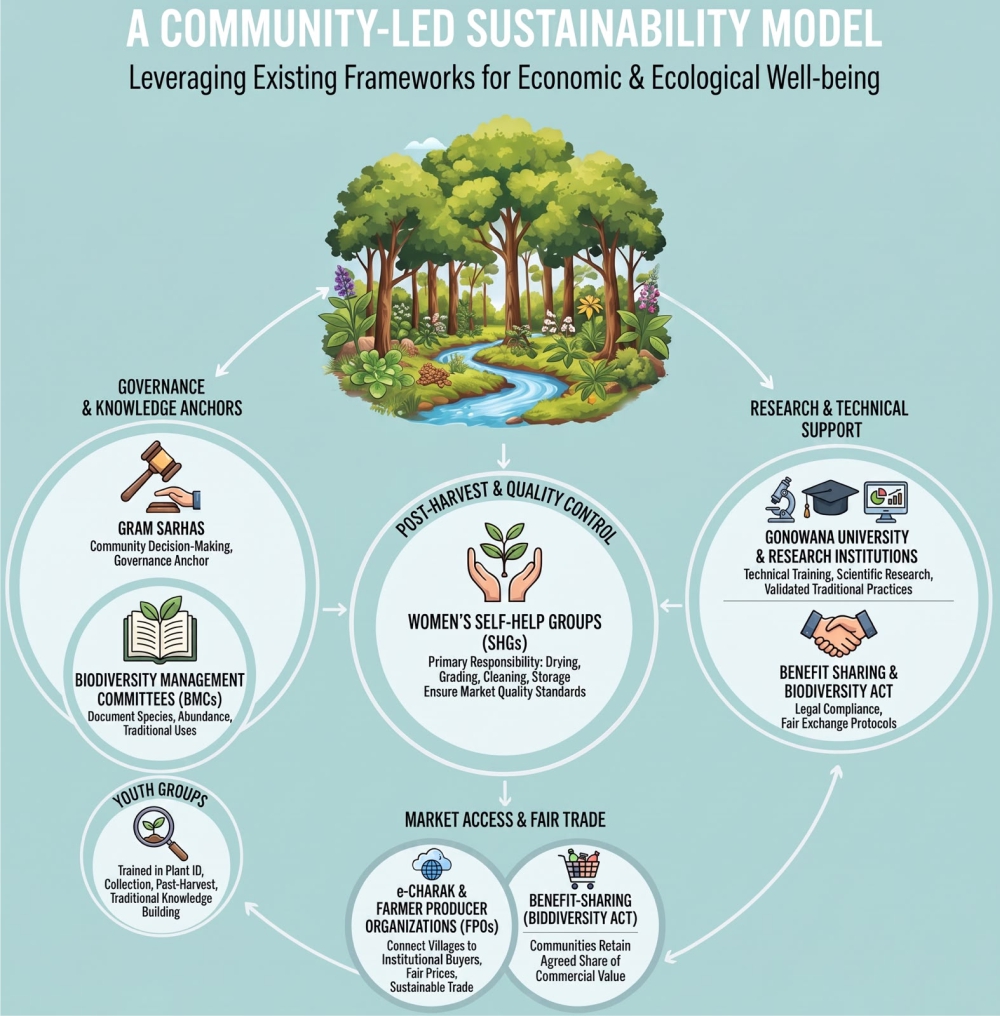
A functional, community-led model integrates Gram Sabhas, BMCs, SHGs, and research institutions into a coherent system where governance, knowledge documentation, and post-harvest processing are managed locally. Market access through e-CHARAK and FPOs ensures fair prices, while benefit-sharing agreements secure community returns. Revenue reinvested into village biodiversity funds makes conservation self-sustaining, requiring only coordination and empowerment within existing frameworks.