From the CPO's Desk
Changing Perspectives of Training and Capacity Building in the Era of Artificial Intelligence
The rapid advancement of Artificial Intelligence (AI), Machine Learning (ML), and digital technologies is fundamentally reshaping how knowledge is accessed, shared, and applied. Training and capacity-building models that once relied heavily on classroom instruction and standardized curricula are now being challenged by adaptive learning systems, digital tools, and data-driven decision-making. However, in this transition, it is critical that the core purpose of training-empowering people with practical, contextual, and usable knowledge-is not diluted.
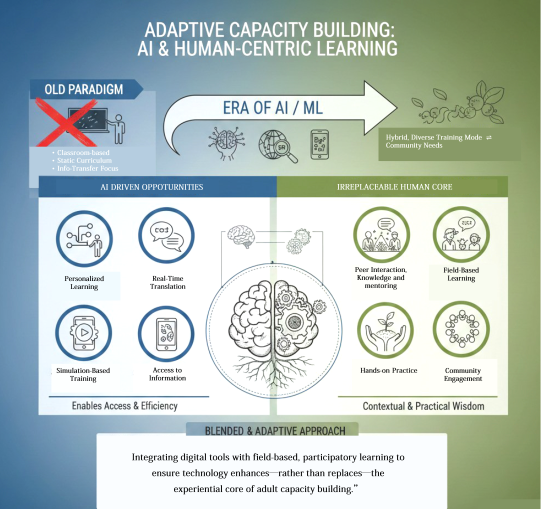
For institutions like the Science and Technology Resource Centre (STRC), Gondwana University, working closely with rural and tribal communities, the shift towards technology-enabled capacity building must be approached thoughtfully. Adult learners bring lived experience, traditional knowledge, and problem-oriented learning needs. They learn best when training is relevant to their daily work, respectful of their knowledge systems, and immediately applicable. Technology should therefore act as an enabler, not a replacement, of human-centric learning processes.
AI-driven tools offer significant opportunities: personalized learning pathways, real-time language translation, digital documentation of indigenous knowledge, simulation-based skill training, and improved outreach through mobile platforms. When used appropriately, these tools can reduce learning barriers, improve access, and enhance the efficiency of training programmes—particularly in remote and resource-constrained regions.
At the same time, capacity building cannot be reduced to digital content delivery alone. Core elements such as field-based learning, peer interaction, mentoring, hands-on practice, and community engagement remain irreplaceable—especially in areas like natural resource management, traditional livelihoods, health practices, and grassroots entrepreneurship. The risk lies not in adopting new technologies, but in adopting them without contextual adaptation.The way forward lies in a blended and adaptive approach. Training programmes must integrate digital tools with participatory methods, combine data-driven insights with experiential learning, and align modern technologies with local realities. Trainers themselves need continuous upskilling—not only in using AI-based tools, but in facilitating learning in hybrid, diverse, and intergenerational environments.
In the era of AI and ML, the role of institutions like STRC becomes even more critical—not as technology promoters alone, but as translators between innovation and community needs. The future of capacity building lies in leveraging emerging technologies while preserving the human, cultural, and experiential core of adult learning. This balanced approach will ensure that technological progress leads to genuine empowerment, not exclusion.
Similarly, in bamboo-based livelihood and enterprise development programmes, digital design tools, online product catalogues, and data-driven market insights are being gradually integrated with hands-on skill training. While AI-enabled platforms can support design optimization, quality control, and market forecasting, the core training continues to focus on craftsmanship, material understanding, tool handling, and local production systems-areas where experiential learning is indispensable.